Powering Indiana, Paying More: Why Blackford County's Renewable Energy Boom Isn't Lowering Local Bills
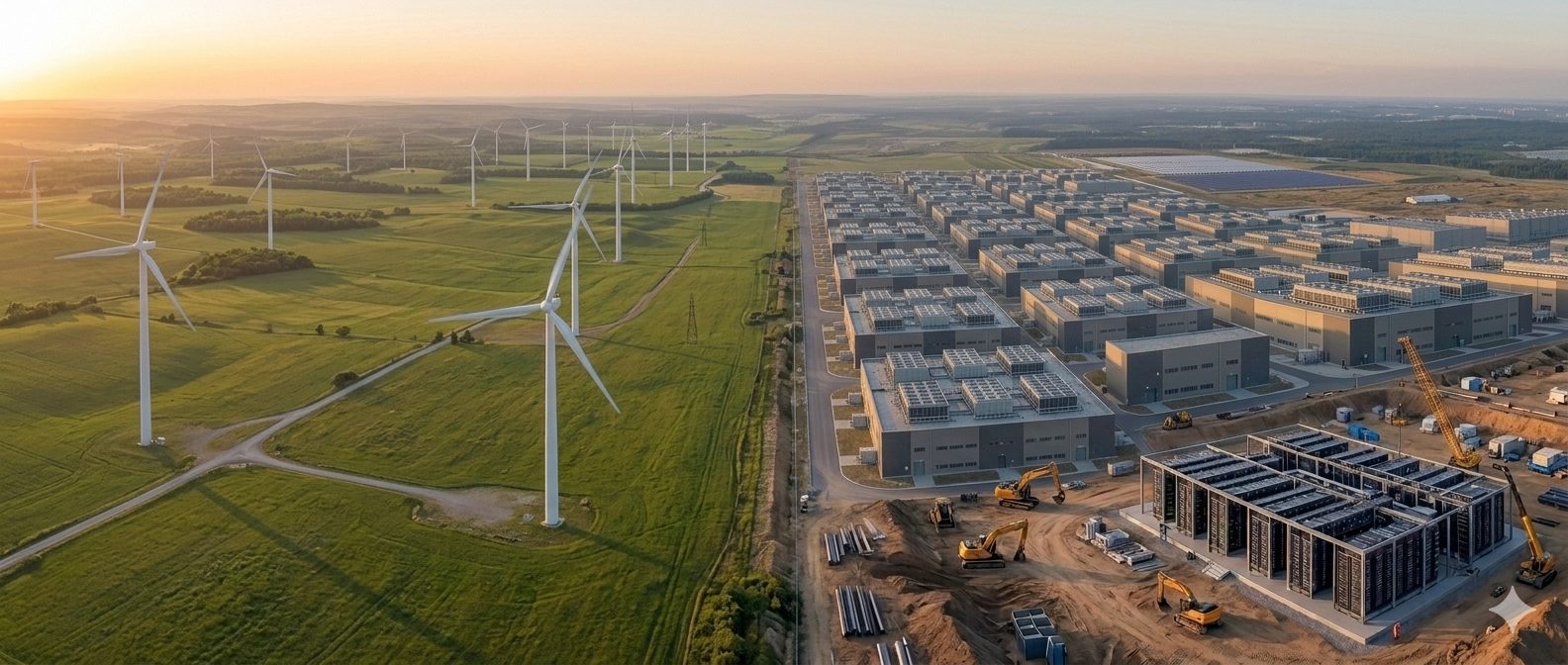
Wind and solar projects are being built across Blackford County. None of the electricity is staying here — and Indiana power bills keep going up, not down.
This is the third article in a series on Blackford County's renewable energy deals. The second article traced the foreign ownership behind every major project in the county. This one looks at a simpler question: where does all this electricity actually go, and why aren't local power bills going down?
When the foreign-owned companies pitched these projects to the county, residents might've been told renewable energy helps lower costs. It is the kind of promise that sounds reasonable. New power being built in your county should mean cheaper power for your home.
But that is not how the system works in Indiana. And the data shows it is not what is happening.
Where the Electricity Actually Goes
In December 2025, RWE Clean Energy signed a 15-year contract with Indiana Michigan Power for 100% of the electricity that Prairie Creek will generate.[^1] Indiana Michigan Power, or I&M, is the utility that buys it all.
That electricity does not stay in Blackford County. It feeds into I&M's grid, which serves about 600,000 customers across northeast and east-central Indiana and southwest Michigan.[^2] From there, it joins the larger regional grid run by PJM Interconnection, which moves electricity across 13 states and the District of Columbia.[^3]
Once the power leaves the wind turbine, it is mixed with electricity from coal plants, natural gas plants, nuclear plants, and other wind and solar projects. The grid does not separate "Blackford County electricity" from any other source. The power could end up serving a home in Fort Wayne, a business in Toledo, or a data center in Pennsylvania.
This is true for every major project in the county. RWE's Prairie Creek goes to I&M. EDF's Lake Trout Solar will be owned by I&M after construction.[^4] The Leeward and EDP projects will sell into the same regional grid through power purchase agreements with utilities or large customers.
No project in Blackford County has signed a contract to deliver electricity to Blackford County residents. That is not how utility-scale energy works in Indiana.
Why I&M Wants the Power
I&M has been clear about why it signed the Prairie Creek deal. In its own press release, the company said the contract is part of an "all-of-the-above strategy to secure generation in response to surging power demand."[^1]
That surging demand is not coming from homes. It is coming from data centers — large industrial facilities that house computer servers for cloud computing, artificial intelligence, and online services. Amazon, Google, and Microsoft have all announced massive new data center projects in Indiana in the past two years, drawing electricity from I&M and other state utilities.
The scale is enormous. Indiana University's Environmental Resilience Institute has reported that in northern Indiana alone, utilities forecast that a handful of proposed data centers will require more electricity by 2030 than all 6.8 million Hoosier households use today.[^5]
This is not a small story. A future Ledger article will look in detail at how the data center boom is reshaping Indiana's electric grid and who is paying for it. For now, the relevant point is simpler: Blackford County's wind farms are being built to help feed a load growth driven by industrial customers, not to lower residential bills.
Indiana Power Bills Are Going Up
If renewable energy lowered electric bills, you would expect to see it in the data after almost two decades of utility-scale wind generation in Indiana.[^6] Instead, the opposite is happening.
The Indiana Utility Regulatory Commission approved residential rate increases averaging 17.5% from 2024 to 2025 — about $28 per month for the average household.[^7] According to the Citizens Action Coalition, Indiana's main consumer utility advocacy group, this was the largest annual increase since at least 2005. It came on top of a 9.3% increase the year before.[^8]
The increases varied by utility:
Utility 2024 Increase 2025 Increase NIPSCO 17.8% 26.7% CenterPoint 7.1% 24.9% Duke Energy Indiana 1.0% 19.8% AES Indiana 11.9% 12.0% Indiana Michigan Power 8.8% 3.9%
I&M had the smallest increases of any major Indiana utility.[^8] But its typical residential bill still ranked third-highest among IURC-regulated utilities in 2025.[^9]
Statewide, Indiana's average residential electricity rate is now about 16.19 cents per kilowatt-hour as of January 2026, up from 14.55 cents per kWh a year earlier.[^10] Nationally, US residential rates have risen 21% in five years.[^11]
Indiana's governor publicly called for lower utility rates in late 2025.[^12] State regulators have shifted too. The Indiana Utility Regulatory Commission, under new chairman Andy Zay, ran an investigation into the state's largest utilities in 2026 and began holding public meetings on rates — which have risen nearly 30% over the past decade.[^19]
Lawmakers have acted as well. A 2025 law, House Enrolled Act 1007 (the enacted version of House Bill 1007), requires a proposed data center or other large new user to commit to covering at least 80% of the cost of new generation built to serve it — even if the project is never built.[^5] A 2026 law, House Bill 1002, created levelized payment plans for customers and required utilities to report more on how households are faring.[^19] But these protections are limited. HEA 1007 applies going forward, not to deals already signed. And 80% is not 100%.
Who Pays for New Power Plants
Here is something that surprises most residents when they learn it: Indiana's regulated utilities make money by spending money.
Under Indiana's cost-of-service regulatory model, utilities like I&M earn a guaranteed rate of return on the capital they invest. As the Citizens Action Coalition has put it, "monopoly utilities earn a rate of return on every one of your dollars they spend, so the more money they spend, the more money they make."[^13]
This means that when I&M signs a contract to buy electricity from a new wind farm, or builds new transmission lines, or upgrades substations to serve data centers, those costs are recovered through customer rates. The utility's profit grows. The customer's bill grows.
An energy policy analyst from the Citizens Action Coalition told reporters in early 2026 that Indiana's major utilities, including I&M, "do not make data centers pay those costs. They pass those costs onto their customers."[^14]
In February 2026, I&M announced a "Customer Benefits Plan" and said it would seek state permission to lower its base rates — the largest single part of most bills. The company's own statement said the decrease was "made possible by the load growth and increased revenue it is experiencing from large customers including data centers."[^12] But as of mid-2026, that base rate cut was still just a plan. I&M said the full details would come in a rate case filing to the IURC later in the summer.[^20]
One smaller reduction did go through. Starting with the June 2026 billing cycle, the average I&M home using 1,000 kilowatt-hours a month saw its bill drop about 3.6%, or roughly $6 a month. That cut did not come from the wind farms, and it was not the base rate cut. It came from the IURC approving a lower charge tied to how I&M buys and sells power on the regional market — the same PJM grid that Blackford County's electricity feeds into.[^21]
So a real reduction happened. It was small, and it had nothing to do with hosting a wind farm. Whether the larger base rate cut actually shows up on bills — net of all the riders, trackers, and capital recovery charges that come with new infrastructure — will be decided in IURC dockets, not press releases.
What Other Indiana Host Counties Have Seen
Indiana has had utility-scale wind farms since 2008. The first projects went up in Benton and White Counties, which together still account for more than half of the state's wind capacity.[^15] Other host counties include Madison, Tipton, Jay, and Randolph.[^16]
If wind farms reliably lowered residential bills in their host counties, that would show up in 17 years of data.
It does not.
A 2020 Purdue University study examined the economic impact of wind energy on Indiana host counties. The benefits the study identified were tax revenue, lease payments, and jobs — not lower electricity rates. In 2019, Benton County collected $4.3 million in property taxes from wind turbines, or $492 per citizen. White County collected $2.3 million, or $94 per citizen.[^17] Statewide, wind lease payments to landowners totaled about $20 million in 2019.[^15]
These are real benefits to the specific landowners who hosted turbines and to county budgets. But the Purdue study did not find evidence that hosting a wind farm produced lower residential electricity rates for the people who lived in those counties. Neither did the U.S. Department of Energy's WINDExchange documentation, which lists tax revenue, land-lease payments, and jobs as the primary local benefits — without specific data tying any individual wind farm to documented residential bill reductions.[^18]
After nearly two decades of utility-scale wind in Indiana, with thousands of megawatts installed, the case that hosting a wind farm has measurably lowered residential bills in Benton, White, Madison, Tipton, Jay, or Randolph County does not appear in the peer-reviewed economic research. The case for tax revenue and lease income very much does.
What Blackford County Should Expect
The pattern from Indiana's other wind host counties tells us what Blackford County can reasonably expect from its own renewable energy buildout:
Real benefits:
Property tax payments to the county (reduced 75% during the 10-year abatement period)
Lease payments to landowners hosting turbines
A small number of construction and minor permanent jobs
Economic Development Agreement payments to the county's discretionary fund
Promises that are not supported by Indiana data:
Lower residential electricity bills for Blackford County homeowners
Reduced power costs as a result of being a host county
Direct local benefit from the electricity generated within county lines
The electricity will leave the county. The profits will leave the country. What Blackford County gets is the project itself — the turbines, the access roads, the substations — and the bounded financial benefits that the developers have committed to in writing.
That is not necessarily a bad trade. It is just a different trade than the one residents were told they were getting.
The Question Worth Asking
When a developer or county official tells residents that a renewable energy project will help the local community, the right question to ask is: "How? And be specific."
The wholesale cost of wind power is genuinely low. That is true. But the wholesale cost is not what residential customers pay. They pay the retail rate, which includes the capital cost of new generation, transmission upgrades, distribution infrastructure, regulatory fees, and the utility's guaranteed rate of return on every dollar it invests.
Adding more wind and solar capacity to the regional grid is broadly good for the grid. It is good for utilities that need new generation to serve growing industrial load. It is good for the developers and their foreign parent companies. It may eventually help moderate wholesale prices in PJM.
What it has not done, in nearly two decades of Indiana history, is reliably lower the residential bill of the homeowner who lives next door to the turbines.
That is the part residents deserve to hear honestly.
Sources
[^1]: RWE Clean Energy, "RWE and Indiana Michigan Power Company partner to support Indiana's growing electricity demand with long-term PPA for 200 MW project," December 18, 2025. https://www.prnewswire.com/news-releases/rwe-and-indiana-michigan-power-company-partner-to-support-indianas-growing-electricity-demand-with-long-term-ppa-for-200-mw-project-302646322.html
[^2]: Indiana Michigan Power corporate information. https://www.indianamichiganpower.com/
[^3]: Federal Energy Regulatory Commission, "PJM Interconnection." https://www.ferc.gov/industries-data/electric/electric-power-markets/pjm
[^4]: EDF Renewables / Indiana Michigan Power Lake Trout Solar agreement. https://www.edf-re.com/press-release/edf-renewables-north-america-signs-agreement-with/
[^5]: Indiana University Environmental Resilience Institute, "Data Centers Fact Sheet." https://eri.iu.edu/resources/fact-sheets/data-centers.html
[^6]: Purdue Extension Community Development, "Profile of the Wind Energy Sector in Indiana." https://www.extension.purdue.edu/cdext/thematic-areas/community-planning/collaborative-projects/_docs/wind-energy/profile-of-the-wind-energy-sector-in-indiana.pdf
[^7]: Just The News, "Indiana's electricity bills have soared, now bill would make utilities prioritize affordability," February 5, 2026. https://justthenews.com/politics-policy/energy/following-rate-increases-indiana-house-passes-bill-make-utilities-prioritize
[^8]: Citizens Action Coalition of Indiana, "Indiana Utility Affordability Crisis." http://www.citact.org/iuac
[^9]: Indiana Office of Utility Consumer Counselor (OUCC), "Indiana Michigan Power (I&M) Rates." https://www.in.gov/oucc/featured-topics/indiana-michigan-power-i-and-m-rates/
[^10]: U.S. Energy Information Administration data, cited in average residential electric bill summary for Indiana. https://www.jackery.com/blogs/knowledge/average-electric-bill-in-indiana
[^11]: Electric Choice, "Electricity Rates by State (May 2026)." https://www.electricchoice.com/electricity-prices-by-state/
[^12]: Utility Dive, "Indiana governor seeks lower utility rates," September 8, 2025. https://www.utilitydive.com/news/indiana-governor-utility-rates-iurc-nipsco-data-center/759465/ — see also Journal Gazette, "Indiana Michigan Power announced it will ask for state permission to reduce base rates," February 25, 2026.
[^13]: Citizens Action Coalition of Indiana, "Indiana Utility Affordability Crisis." http://www.citact.org/iuac
[^14]: Mirror Indy, "How data centers in Indianapolis could affect your electric bill," March 2, 2026. Quoting Ben Inskeep, energy policy analyst. https://mirrorindy.org/indianapolis-data-centers-raise-electric-bills-aes-duke/
[^15]: Inside Climate News, "Wind Energy Is a Big Business in Indiana, Leading to Awkward Alliances," March 30, 2021. https://insideclimatenews.org/news/30032021/indiana-wind-energy/
[^16]: Purdue Extension, Indiana wind sector profile (see [^6]).
[^17]: Purdue University News, "Study reviews impact of wind energy on local Indiana communities," September 10, 2020. https://www.purdue.edu/newsroom/releases/2020/Q3/study-reviews-impact-of-wind-energy-on-local-indiana-communities.html
[^18]: U.S. Department of Energy WINDExchange, "Local Impacts." https://www.energy.gov/eere/wind/windexchange/local-impacts
[^19]: Indiana Public Media, "Statehouse push for affordable power collides with data center growth," May 2026. https://www.ipm.org/news/2026-05-22/statehouse-push-for-affordable-power-collides-with-data-center-growth
[^20]: WNDU, "Indiana Michigan Power plans to file for base rate reduction this summer," February 24, 2026. https://www.wndu.com/2026/02/24/indiana-michigan-power-plans-file-base-rate-reduction-this-summer/
[^21]: Indiana Michigan Power customer bill reduction (Off System Sales Margin Sharing/PJM Cost Rider), effective June 2026 billing cycle, reported May 2026. https://wtlcfm.com/4235354/indiana-michigan-power-announces-lower-bills-for-customers/
This is the third article in a series on Blackford County's renewable energy deals. The second article examined the foreign ownership behind every major project in the county. The next article will examine how the data center boom is reshaping Indiana's electric grid — and who is paying for it.
About our reporting: The Blackford Ledger builds its government coverage from official public records, and every report is reviewed by an editor before publication. Read our Editorial Policy & Corrections or request a correction.