Foreign Owners, Local Costs: How Blackford County's Energy Deals Send Profits Overseas
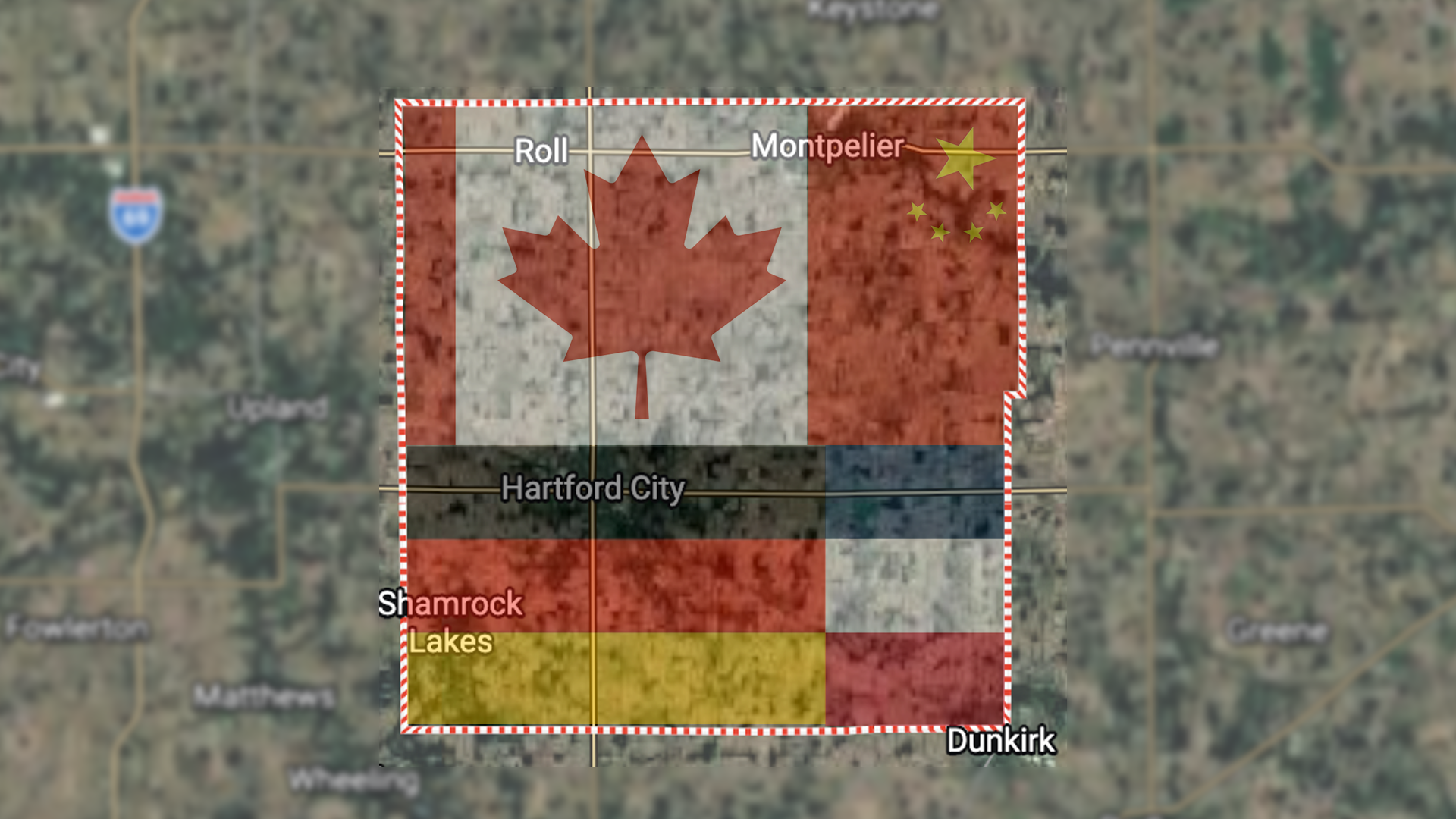
Every major energy company seeking to build in Blackford County is owned by a foreign government or foreign investor. One has ties to a Chinese state-owned company. Local residents are paying for their tax breaks.
CORRECTION (May 11, 2026): An earlier version of this article overstated the per-household dollar impact of the Prairie Creek Phase 2 tax abatement. The article originally stated that homeowners with $100,000 of taxable property value would forego approximately $150 per year, or $1,500 over 10 years, in tax relief due to the abatement. Based on the official Baker Tilly preliminary fiscal impact analysis obtained from the Blackford County Auditor's office, the actual figures are smaller. For a $100,000 home in Washington Township, the abatement provides about $14.95 per year in tax relief instead of the approximately $55.20 per year residents would have received without the abatement — a foregone savings of roughly $40 per year, or approximately $400 over the 10-year abatement period. The direction of the analysis — that residents pay more under the abatement than they would have without it — is unchanged. The corrected figures are reflected below. The Ledger thanks the Blackford County Council member who flagged the error.
Foreword from the author: This article is part of an ongoing investigation into the impact that outside energy companies have on our community that began with our piece on the approval of an $11.3 million abatement.
Though Blackford County is in dire need of new revenue streams, the renewable energy avenues might bring empty promises to our county, or at the very least, no long-term solutions to our right-now problems, only distracting our limited resources on hollow solutions.
On May 6, 2026, the Blackford County Council voted 6-0 to give a German company a tax break worth $11.3 million.[1]
The company is RWE Clean Energy. It is a U.S. branch of RWE AG, a power company based in Essen, Germany.[2] The deal lets RWE pay 75% less in property taxes on its new wind farm for 10 years. Instead of paying about $1.5 million per year, RWE will pay around $316,000 per year.[1]
There are multiple claims for why this deal took place the way it did. We'll dive into those claims in a later article, though.
Right now, four foreign-owned companies are building or planning energy projects on Blackford County land. None of them are American. Their profits flow to Germany, Canada, Portugal, France — and indirectly to a Chinese state-owned company. Together, they represent more than $1.3 billion in investment and over 1,000 megawatts of energy infrastructure.
And in nearly every case, they are asking for — or already receiving — tax breaks that shift the cost to Blackford County residents.
The Foreign Owners
Here is who is actually behind the four energy companies operating in Blackford County.
RWE Clean Energy (Germany)
RWE Clean Energy is building Prairie Creek Wind, a 200-megawatt project split into two phases. Phase 2 just received the 75% tax abatement.[1] The U.S. branch is based in Austin, Texas. Its parent company, RWE AG, has been headquartered in Essen, Germany since 1898.[2] RWE is one of the largest energy companies in Europe. The profits from Prairie Creek are likely to flow to Germany.
Leeward Renewable Energy (Canada)
Leeward is building two projects in Blackford County: Blackford Wind (200 megawatts) and Blackford Solar (150 megawatts).[3] Leeward is owned by OMERS, a Canadian government pension fund.[4] OMERS is currently trying to sell a large stake in Leeward — possibly worth $3 to $4 billion — to other foreign investors.[5] That means the company building Blackford Wind could be owned by someone else entirely before the project even finishes.
EDP Renewables (Portugal — with a Chinese tie)
EDP Renewables is in talks to build Teays River Wind ($356 million, 200 megawatts) and Teays River Solar ($140 million, 100 megawatts) just east of Hartford City.[6] The U.S. branch is owned by EDP Group, a Portuguese energy company.[7]
Here is the part most residents do not know: The largest single shareholder of EDP Group is China Three Gorges Corporation, a Chinese state-owned company. It owns 21.4% of EDP.[8] China Three Gorges is controlled by the Chinese government.[9]
That means when EDP Renewables earns money from Blackford County resources, a portion of that profit flows up through Portugal to a company controlled by China.
EDF Renewables (France)
EDF Renewables — now called EDF Power Solutions North America — is building Lake Trout Solar, a 245-megawatt solar project near Montpelier.[10] EDF will sell the finished project to Indiana Michigan Power. But while it is being built, EDF runs the show.
In June 2023, the French government bought the rest of EDF and made it 100% state-owned.[11] EDF is now fully owned by the government of France.
How Foreign Companies Look Local
If you read the council meeting notes, you will see "RWE Clean Energy LLC" listed as the company getting the tax break. You will not see "RWE AG, Essen, Germany."
This is on purpose.
Every foreign energy company uses U.S. limited liability companies — LLCs — to do business here. The local LLC signs the contracts. The local LLC gets the tax break. The local LLC appears at council meetings. The foreign parent stays in the background.
There are real benefits for these companies in using LLCs:
The LLC pays no corporate income tax. Profits pass straight to the foreign parent.[12]
The foreign parent can charge the LLC fees, management costs, and interest — moving money out of the U.S. as tax-deductible expenses.
Federal tax credits for wind and solar projects flow through the LLC to the foreign owner.
LLC ownership is not always public. The county may not know if ownership changes.
The county is negotiating with what looks like a local American business. But the money — and the decisions — come from somewhere else.
Who Pays for the Tax Break
When the council approved RWE's 75% abatement, it removed most of RWE's property value from the county's tax rolls for 10 years.
In return, RWE agreed to pay the county $7.8 million directly through an Economic Development Agreement.[1] Supporters said this was a fair trade.
But here is what was not explained clearly at the meeting:
Indiana law caps how much total property tax the county can collect each year.[13] When a $250 million wind farm is fully on the tax rolls, it adds value to the county's tax base. That bigger tax base means everyone's tax rate drops a little, because the same total bill is spread across more property value.
According to the official Baker Tilly fiscal impact analysis prepared for the Blackford County Council, residents in Washington Township will see their property tax rate drop from $1.8229 to $1.7730 per $100 of assessed value during the 10-year abatement period — a difference of about 5 cents.[20] After the abatement expires, the rate is projected to drop further to $1.6387 — a difference of about 18 cents from the current rate.
For a home with $100,000 of assessed value in Washington Township, the math works out like this:
Period | Annual Tax Savings | What This Means
During the 10-year abatement | About $14.95 per year | Modest relief
After the abatement expires | About $55.20 per year | Larger relief
Foregone savings during abatement | About $40 per year | What residents miss out on
For a $200,000 home, those numbers roughly double — about $30 in annual savings during the abatement versus about $110 per year after, for a foregone savings of roughly $80 per year, or about $800 over the 10-year period.[20]
Across thousands of Blackford County homes, that foregone savings adds up. The neighboring Licking and Harrison townships show similar patterns, with rate reductions during the abatement of about 5 cents and post-abatement reductions of about 19 cents.[20]
The county gets the EDA money. RWE gets the tax break. Residents get partial relief instead of the full rate reduction they would have received from full assessment.
And this is just one of multiple projects.
The Jobs Question
When the energy companies pitched these projects, they promised jobs. Here is what they have actually committed to in writing.
RWE Prairie Creek will hire 240 workers during peak construction, with 6 to 8 permanent positions once it is running.[14] EDP's Teays River Wind farm has committed to 8 to 10 permanent jobs. Teays River Solar promises 2 to 4 permanent jobs.[6] Leeward — which is building both Blackford Wind and Blackford Solar — has not published specific job numbers at all. Their websites only say the projects will bring "an influx of new jobs."[3][15]
Add it all up. Across more than $1.3 billion in projects covering more than a thousand megawatts of energy, the foreign-owned companies have publicly committed to fewer than 25 permanent jobs in Blackford County.
The construction jobs are real but temporary. They last 12 to 18 months. The word "peak" in RWE's 240-worker figure means the single highest number at any moment — not 240 jobs that last the whole project. Most of the specialized work — crane operators, turbine erectors, electrical engineers — comes from contractors who travel from project to project. Industry data shows that only about 20 to 30 percent of construction labor on wind projects is sourced from the local area.
So the real number of Blackford County residents who might find work during construction is probably 50 to 70 people, for just over a year.
In a county of roughly 12,000 people, that is the local job total for over $1 billion in foreign investment.
The Manufacturing Question
The other promise was that wind and solar would bring American manufacturing back.
It is not coming to Blackford County.
Indiana has some component makers — iron, steel, gears, bearings. But there is no major wind turbine factory in the state.[16] No company makes blades, nacelles, or towers in Indiana. These three parts make up nearly 80% of the entire cost of a wind turbine.[19]
The big parts for these Blackford County projects will come from somewhere else. Wind turbine blades and nacelles for U.S. projects are typically manufactured in Iowa, Texas, Colorado, Denmark, Germany, and Spain.[17] Solar panels are mostly imported, with significant volume coming from Southeast Asia and China.
None of the developers have committed to using Indiana-manufactured parts for the Blackford County projects. RWE's marketing language mentions "supporting the renaissance of American industry," but no project-specific Indiana manufacturing commitments have been made public.
The $250 million RWE will spend on Prairie Creek mostly leaves Indiana before construction even starts — going to the manufacturers in other states and other countries who actually make the parts. What gets paid here are the construction crews and a handful of permanent jobs. What stays here is land covered in foreign-owned turbines.
The bottom line: These projects bring no long-term job stability to Blackford County.
Where the Money Goes
Supporters say these projects bring "lots of money" to the county. Some money does flow in, according to the RWE deal:
The $7.8 million EDA payment from RWE
Lease payments to landowners who host turbines
$1,000 per year for households within 1,750 feet of a turbine[1]
Wages for the construction work that is sourced locally
A handful of permanent operations jobs
But far more flows out:
The $250 million project cost goes mostly to manufacturers outside Indiana and outside the U.S.
Long-term profits flow to Germany, Canada, Portugal, France, and indirectly China.
The $11.3 million abatement is money kept by RWE — not invested in Blackford County.
Engineering, management, and major decisions happen outside the county.
The Questions That Need Answers
The Blackford County Council approved RWE's deal 6-0. A seventh member was disconnected on the phone before the vote.[1] The vote happened even though residents asked for it to be delayed until a third-party auditor finished reviewing the county's energy deals.[1]
Three more major projects — Lake Trout Solar, Teays River Wind, and Teays River Solar — are still in active negotiation.[18] All three involve foreign-owned companies. The Teays River projects are owned by a company with significant Chinese state-owned investment.
Residents deserve to know:
Did the county know about these ownership structures before approving the deals?
Are the same 75% abatements being offered to every project?
Do the companies that actively employee Blackford County residents see any tax abatements that can help keep them afloat?
Does the county have any protections if ownership changes — for example, if OMERS sells Leeward to a new foreign buyer mid-construction?
Has anyone studied the combined impact of all these tax breaks on resident property tax bills?
Has the county consulted federal officials about Chinese state-owned investment in local energy infrastructure?
Have any developers committed to using Indiana-manufactured parts or hiring local labor at a specific percentage?
When the Blackford County Council gave RWE a $11.3 million tax break, it did not just give a tax break to a wind farm. It gave a tax break to a German energy company — in exchange for fewer than 10 permanent jobs.
The next three deals will do the same thing. Unless someone asks the right questions, residents will keep paying for it.
Sources
[1]: Blackford County Council meeting, May 6, 2026. YouTube transcript: https://www.youtube.com/watch?v=0v4VvRGb95w
[2]: RWE AG corporate information. https://en.wikipedia.org/wiki/RWE | https://www.rwe.com/en/the-group/
[3]: Blackford Wind Fact Sheet (Leeward Renewable Energy). https://blackfordwind.com/ | https://blackfordwind.com/wp-content/uploads/2025/05/Blackford-Wind-Facts-Rev-5.5.25.pdf
[4]: OMERS Infrastructure acquisition of Leeward Renewable Energy. https://www.omersinfrastructure.com/news/omers-infrastructure-announces-agreement-to-acquire-leeward-renewable-energy/ | https://www.lreus.com/about-us/
[5]: ION Analytics, "OMERS sale of Leeward Energy enters second round." https://ionanalytics.com/insights/infralogic/omers-sale-of-leeward-energy-enters-second-round/
[6]: EDP Renewables — Teays River Wind and Solar fact sheets. https://edp.com/sites/default/files/document/2026-01/IN%20Teays%20River%20Wind%20Fact%20Sheet_0.pdf | https://edp.com/sites/default/files/document/2025-06/IN%20Teays%20River%20Solar%20Fact%20Sheet.pdf
[7]: EDP Renewables corporate structure. https://en.wikipedia.org/wiki/EDP_Renov%C3%A1veis | https://en.wikipedia.org/wiki/EDP_Renewables_North_America
[8]: EDP Group official shareholder structure (primary source — EDP investor relations). https://edp.com/en/investors/share/shareholder-structure
[9]: China Three Gorges Corporation — state-owned status. https://en.wikipedia.org/wiki/China_Three_Gorges_Corporation
[10]: EDF Renewables / Indiana Michigan Power — Lake Trout Solar announcement. https://www.edf-re.com/press-release/edf-renewables-north-america-signs-agreement-with/ | https://www.gem.wiki/Lake_Trout_Solar_Project
[11]: EDF Group renationalization (2023). https://en.wikipedia.org/wiki/EDF_Renewables | https://www.edf-re.com/about-us/who-we-are/
[12]: U.S. LLC pass-through taxation — Internal Revenue Service. https://www.irs.gov/businesses/small-businesses-self-employed/limited-liability-company-llc
[13]: Indiana Senate Bill 1 (2025), maximum levy growth quotient and property tax caps. https://legiscan.com/IN/bill/SB0001/2025 | Analysis: https://www.ksmcpa.com/insights/indiana-sb-1-brings-major-property-tax-reforms-with-potential-local-income-tax-consequences/
[14]: RWE / Indiana Michigan Power Press Release, December 18, 2025 — Prairie Creek workforce figures. https://www.prnewswire.com/news-releases/rwe-and-indiana-michigan-power-company-partner-to-support-indianas-growing-electricity-demand-with-long-term-ppa-for-200-mw-project-302646322.html
[15]: Blackford Solar official project page. https://blackfordsolar.com/
[16]: Indiana Business Research Center, Kelley School of Business — Indiana wind manufacturing landscape. https://www.incontext.indiana.edu/2011/may-jun/article3.asp
[17]: U.S. Department of Energy, Wind Manufacturing and Supply Chain. https://www.energy.gov/cmei/systems/wind-manufacturing-and-supply-chain
[18]: Hartford City News Times, April 15, 2026. https://www.hartfordcitynewstimes.com/news/three-seek-commissioner-nomination/article_608c3768-50c1-4c9d-abc6-cf4ef9915dd7.html
[19] Breaking down the costs of wind turbine components https://www.canarymedia.com/articles/enn/breaking-down-the-costs-of-wind-turbine-components
[20] Baker Tilly, "Proposed Prairie Creek Wind Farm II — Estimated Taxpayer Impact from the Proposed Incentive," preliminary fiscal impact analysis prepared for the Blackford County Council, 2026. Full document available from the Blackford County Auditor's office.
This article focuses on the foreign ownership of energy companies operating in Blackford County, the tax breaks they receive, and the limited local economic benefits they have committed to. A follow-up article will examine how the abatements will affect resident property tax bills in 2031, when Indiana's standard homestead deduction is fully phased out under SB 1 — while the wind farm tax breaks still have years left to run.
About our reporting: The Blackford Ledger builds its government coverage from official public records, and every report is reviewed by an editor before publication. Read our Editorial Policy & Corrections or request a correction.