BZA Denies Lake Trout Solar Appeal, Finding the Project Met Its Deadlines
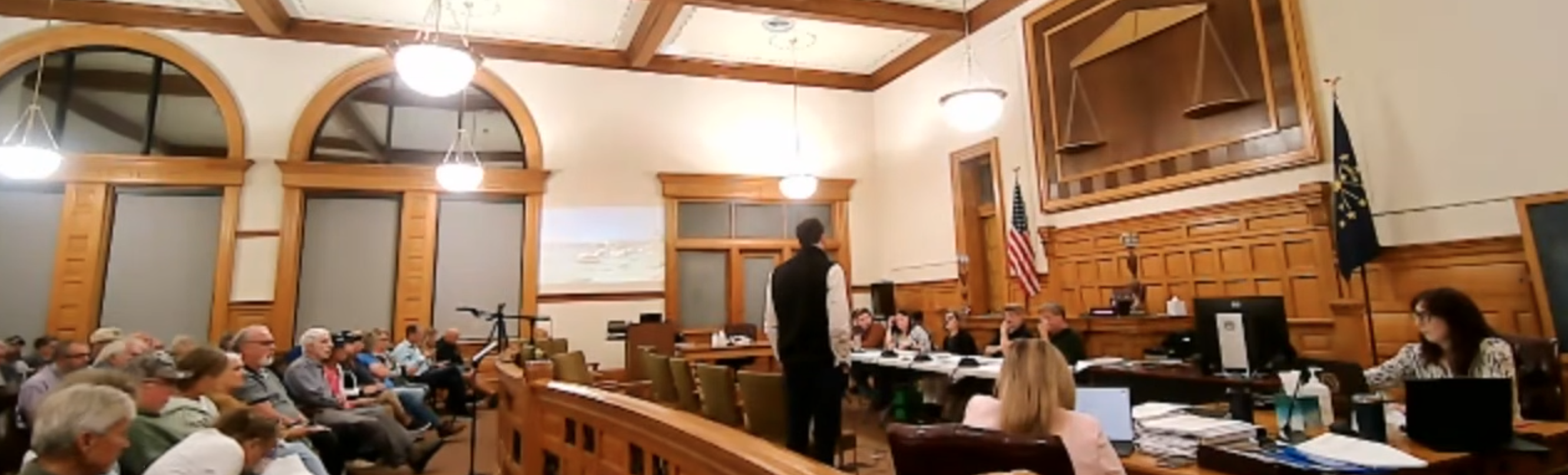
The Blackford County Board of Zoning Appeals voted 4-1 Tuesday night to deny an appeal that sought to void the Lake Trout Solar project's permits.
The project keeps its approvals and its construction continues.
The hearing ran about three and a half hours. Board member Kerra Armstrong cast the only vote in favor of the appeal.
The appeal concerned the "issuance of improvement location permit and failure to cancel void permits," according to the meeting agenda.
What the appeal argued
A group of neighboring property owners, represented by attorney Laureen White, asked the board to find that Lake Trout's permission to build had run out before it ever started building.
The timeline is the whole case.
The BZA approved Lake Trout's special exception on June 28, 2022. The approval gave the company two years to start construction, with the planning and zoning director able to add one more year. That put the deadline at June 28, 2025.
Lake Trout applied for its 44 improvement location permits on June 27, 2025 — one day before the deadline. Former Executive Director Ann Owen issued those permits on October 21, 2025, nearly four months later.
White's argument was that applying for a permit is not construction.
Your ordinance doesn't say that they need the vested right. It says that they need to start construction.
She pointed the board to Indiana court decisions holding that buying land, surveying, financing and clearing lots are not building. If no construction had begun by June 28, 2025, she argued, the approval expired on its own, and the permits Owen issued four months later rested on nothing.
What Lake Trout argued
Lake Trout's attorney, Rachel Connor, told the board the company met the deadline by filing on time.
Her argument turned on three words in the county ordinance: "construction in earnest."
We're arguing yes, that construction in earnest is the work that goes into planning for actual construction once we've got our approval.
Connor said a company cannot legally break ground without a permit, so obtaining permits is the first step of construction, not something that happens before it. She listed the approvals Lake Trout had to collect after 2022 — an economic development agreement, a road use agreement, a drainage board approval, a state stormwater permit — and said none of it could have happened without the 2022 zoning decision.
Jesse Laniak, the project's development manager, made the same point.
The ordinance does not just say construction after three years. It says construction in earnest.
Connor also argued the appeal should not have been heard at all, saying the petitioners lacked standing and that any challenge belonged in court within thirty days of the 2022 decision.
Teresa Dodd, who sued the county over a different solar project, answered that from the floor during public comment. She said the judge in her case told her to come to the BZA first.
When it was all said and done, the judge told us that we were to go before the BZA.
The second question: did work start?
Each of the 44 permits said work had to begin within six months. That set a second deadline of April 21, 2026.
Laniak told the board Lake Trout broke ground on April 14, 2026, a week early. He said the company has improved more than 20 miles of county roads at a cost of $3.5 million, started work on the project substation in December 2024, and will plant cover crop across the site beginning November 1.
White told the board that road work does not count, because it was done under a separate agreement with the county commissioners rather than under the zoning permits. She said no construction had begun on any of the 44 parcels.
Connor agreed the road work sits outside the permits, and said that was the point — the county does not issue itself permits for its own roads.
What the record could not settle
Several questions came up that nobody in the room could answer.
Two required items on Lake Trout's permit application — manufacturer's specifications and a revegetation plan — were not checked off. Connor said the documents were submitted as exhibits and she could not explain the form. "I don't know why they weren't checked. I really don't."
Board attorney John Moynihan told members the answer depended on Owen's filing habits, which nobody present knew.
Owen no longer works for the county. She told Deb Grider, who had been requesting county records on the project, in January 2025 that she no longer has recordings of the 2022 hearing.
The minutes of that hearing exist in two versions. Grider told the board the copy she received in December 2024 showed no vote at all on the special exception, and that a copy produced in August 2025 — with the same number of pages — showed a motion, a second and a 5-0 roll call.
The minutes that they refer to so much — which ones are accurate?
The board did not resolve which copy is the record. One member suggested postponing the vote to gather more information.
You can postpone and try to dig a little bit more. Get some more information.
Daniel Schriver, who chaired the hearing, replied that he was not sure the claims made a difference, and that the decision would be challenged either way. The board voted.
Who spoke
About fifteen people spoke, and several letters were read into the record.
Neighboring property owners asked the board to apply the ordinance as written. Several said the county's rules should apply the same way to a large company as to a local farmer or homeowner.
Amber Reynard, one of the property owners who brought the appeal, told the board what the project would change for her family. She described her three-year-old granddaughter doing chores with her husband and walking out to check the corn and beans.
If these fields are turned into industrial solar development, that changes everything.
Speaking for the project were a representative of Cupertino Electric, the contractor building it; a union official who said the local membership has grown to about 65 members in Blackford County; a representative of Indiana Michigan Power, which has agreed to purchase the project from EDF; and the Indiana Land and Liberty Coalition. Participating landowners read a signed letter citing nearly $15 million in new tax revenue and a roughly $10 million decommissioning bond.
One participating landowner asked the board whether reversing the approvals could leave the county owing the developer money. Connor told the board that if the matter goes to court, her filings will show $143 million spent to date.
Microphones off
At several points during the board's deliberation, members can be seen on the county's recording turning their microphones off and conferring. People in the room say the discussion could not be heard from the gallery.
Indiana's Open Door Law requires that meetings of public bodies be open "at all times for the purpose of permitting members of the public to observe and record them," and it counts deliberating as official action.
What happens next
The board must file a copy of its decision in the office of the board within five days, along with written findings of fact explaining it.
The petitioners' remaining option is a petition for judicial review in court. Indiana Code 36-7-4-1605 requires that it be filed "not later than thirty (30) days after the date of the zoning decision." That clock started Tuesday.
Blackford County's Board of Zoning Appeals is appointed, not elected, and no single body appoints it. According to the meeting agenda, Schriver is appointed by the county commissioners, Lori Kingery represents the Hartford City mayor, Bill Smith represents the Montpelier mayor, Kelly Earle represents Shamrock Lakes, and Armstrong represents the Area Plan Commission.
All five terms run through December 2026.
About our reporting: The Blackford Ledger builds its government coverage from official public records, and every report is reviewed by an editor before publication. Read our Editorial Policy & Corrections or request a correction.