Wind Farm Setbacks in County Agreement Sit at the Low End of National and Industry Standards
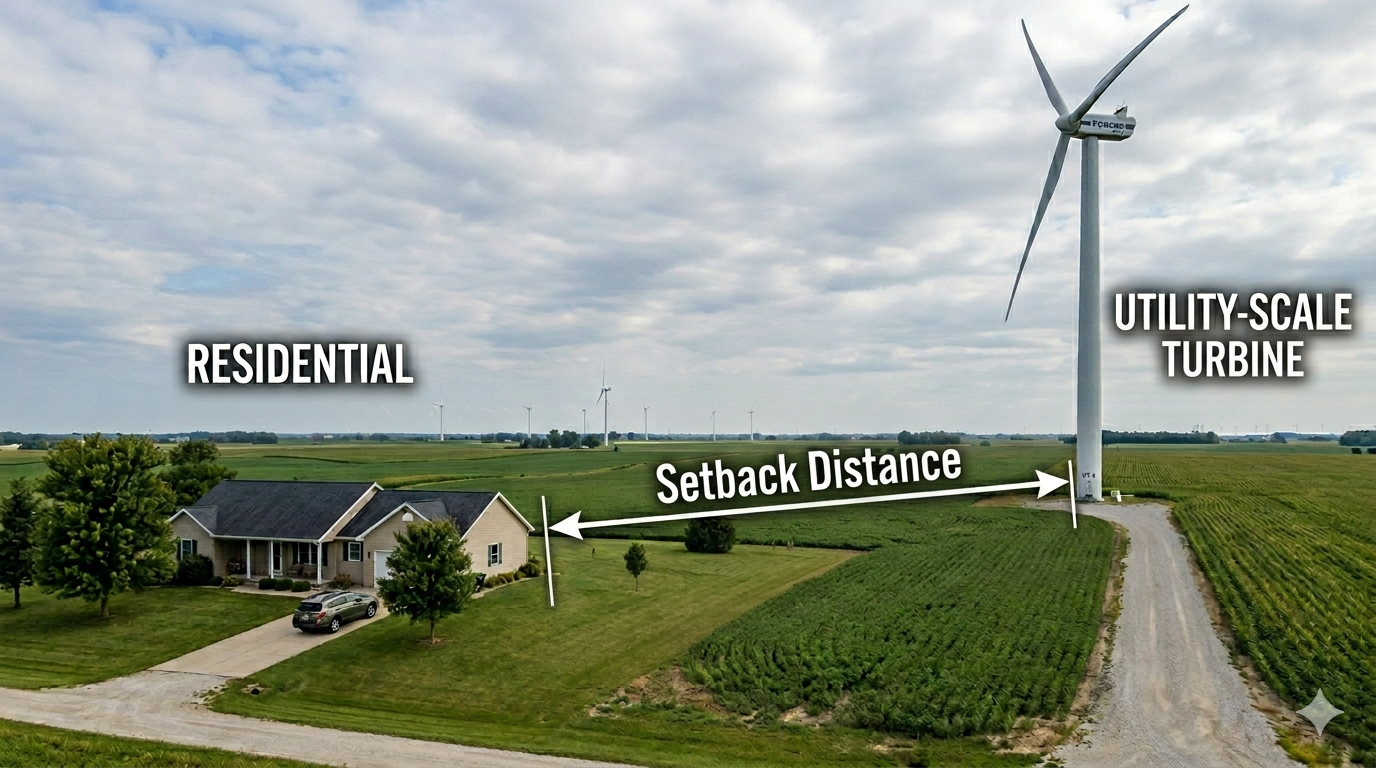
A wind turbine setback is not a courtesy. It is a fall zone. An avoidance area for safety precautions.
When a turbine blade fails, when ice flies off a spinning rotor, or when a tower comes down, the debris has to land somewhere. The setback — the distance a turbine must keep from a home, a road, or a neighbor's property line — is the engineering answer to a blunt question: how far away does the machine have to stand so that when something goes wrong, it goes wrong on the operator's land and not on someone else's?
RWE knows this, and says so in its own filings. In a permit application for its Baron Winds project in New York, the company explains that setbacks exist to keep turbines from being placed where people or buildings sit inside the "fall-down distance" — the area that can be struck by a failing turbine — and it ties that distance to the full height of the machine.
The Economic Development Agreement the Blackford County Commissioners approved a resolution for on June 15 for the second phase of RWE's Prairie Creek wind project sets how close the project's turbines may stand to homes and property lines: 1,000 feet from a residence and 750 feet from a property line. This is less than the distance RWE's own representative has called the industry standard. It is less than what the national record shows most communities require. And it is less distance than turbine manufacturers say to keep clear when one of their machines is on fire or spinning out of control.
What RWE has called the industry standard
The clearest measure of whether 750 feet is a lot or a little is the one RWE supplied itself.
At an ordinance proceeding in Pottawattamie County, Iowa, RWE development outreach manager Julie Drennen told local officials that the standard the company supports — the one she called "an industry standard" — is 1,500 feet from a non-participating home and 1.1 times the turbine's total height from a non-participating property line, according to the Daily Nonpareil of Council Bluffs.
Hold that against the Blackford agreement: from homes, RWE's stated standard is 1,500 feet; the agreement requires 1,000. From property lines, RWE's stated standard scales with the height of the turbine — the taller the machine, the farther back it goes; the agreement replaces that with a flat 750 feet that does not move no matter how tall the turbines turn out to be. The developer agreed, in Blackford County, to less than the developer says is standard.
What "standard" actually means
There is no federal setback requirement for wind turbines, and no single national setback standard. Setbacks are set by counties and municipalities, and the only federal review of turbine placement is by the Federal Aviation Administration, which evaluates each turbine's tip height for aviation safety. Everything else — how close a 600-foot machine can stand to the bed where a child sleeps — is left to local governments.
That makes the question "what is normal?" important, and the most authoritative answer comes from the National Renewable Energy Laboratory, a U.S. Department of Energy lab that maintains the national database of local wind ordinances. It is the catalog researchers and regulators reach for. NREL's data shows turbines are typically kept 300 meters — about 984 feet — or more from features like property lines, with roughly a third of communities requiring even larger setbacks.
The National Wind Coordinating Committee, a body that brought together wind-industry representatives, government agencies, and other stakeholders to develop siting guidance, has recommended setbacks of 1.25 to four times turbine height from adjacent property lines and 1.25 to six times turbine height from public roads — a recommendation shaped in part by the industry itself, not its critics. Each of those benchmarks is larger than the 1.1-times-height formula in the county's ordinance, and well above the flat 750 feet in the agreement.
What the manufacturers say when the machine fails
Other widely used standards are larger still — and the most relevant of these come from the turbine manufacturers themselves, whose engineers set the distances at which their own equipment is considered safe.
A Vestas safety manual, cited in a Massachusetts proceeding, instructs that no one be allowed within 1,640 feet of a "runaway" turbine — one that has lost control of its own rotor. A Nordex manual sets the same kind of line at 500 meters when a turbine is on fire, because parts can fall from it. General Electric's published siting guidance recommends an additional buffer of about 558 feet beyond the fall zone, specifically to account for ice thrown from the blades. Engineers who have modeled blade failure have calculated fragments traveling 1,440 to 1,935 feet, and a real turbine failure once threw large pieces of blade roughly 1,640 feet. Some local ordinances go further: communities in Wisconsin commonly set setbacks of one-half mile — 2,640 feet — from homes and workplaces.
Set those against a 750-foot property line. The distance at which Vestas tells people to stay clear of a runaway turbine is more than twice the distance RWE agreed to keep its turbines from a neighbor's land. The story those manufacturer numbers tell is not that 750 feet is unattractive. It is that 750 feet is inside the range where, by the equipment-makers' own reckoning, things can land.
Why a company wants the line drawn close
None of this is mysterious from RWE's side, and it is worth stating plainly rather than darkly. Shorter setbacks are worth money.
Every foot a turbine must keep from a property line subtracts usable ground from a project. Longer setbacks mean fewer turbines fit, or that turbines get pushed onto weaker wind, or that the developer has to sign leases with still more neighbors to buy the spacing. A shorter property-line setback in particular lets a company crowd turbines toward the edges of the land it has already leased — which can be the difference between a turbine that fits on a field and one that doesn't get built. Seven hundred fifty feet instead of a height-based figure that could run past a thousand is not a small concession. It is buildable land.
The people on the other side of that math are the neighbors who did not sign a lease, receive no check, and now have a turbine standing 750 feet from a property line they own — closer than the company's own safety standard, the federal database, and the manufacturers' own manuals all suggest it should be.
Sources
RWE Baron Winds Article 10 application, Exhibit 6 (fall-down distance and setback safety rationale). https://americas.rwe.com/-/media/RWE/documents/11-forschung-und-entwicklung/baron-winds/article-10/08-application/01-exhibits/baron-winds-article-10-exhibit-06.pdf
"Setback distance and air traffic safety are top concerns for proposed wind farm," Daily Nonpareil (RWE's Julie Drennen on the 1,500-foot / 1.1x "industry standard"). https://nonpareilonline.com/news/local/government-politics/pottawattamie-county-wind-solar-energy-ordinance/article_f11e8d12-8eef-11ee-a47d-23cbc28db2a6.html
U.S. Department of Energy, WINDExchange — Wind Energy Ordinances (setback definitions, height measurement, FAA role). https://windexchange.energy.gov/projects/ordinances
National Renewable Energy Laboratory, wind ordinance database and structure-setback dataset. https://catalog.data.gov/dataset/wind-turbine-structure-setbacks-ordinances-2022-and-extrapolated-trends-115-hub-height-170
June 15, 2026 Blackford County Commissioners meeting (setback figures).
About our reporting: The Blackford Ledger builds its government coverage from official public records, and every report is reviewed by an editor before publication. Read our Editorial Policy & Corrections or request a correction.