The Teays River "Good Neighbor Agreement" Is Not a Payment for Inconvenience. It's a Release.
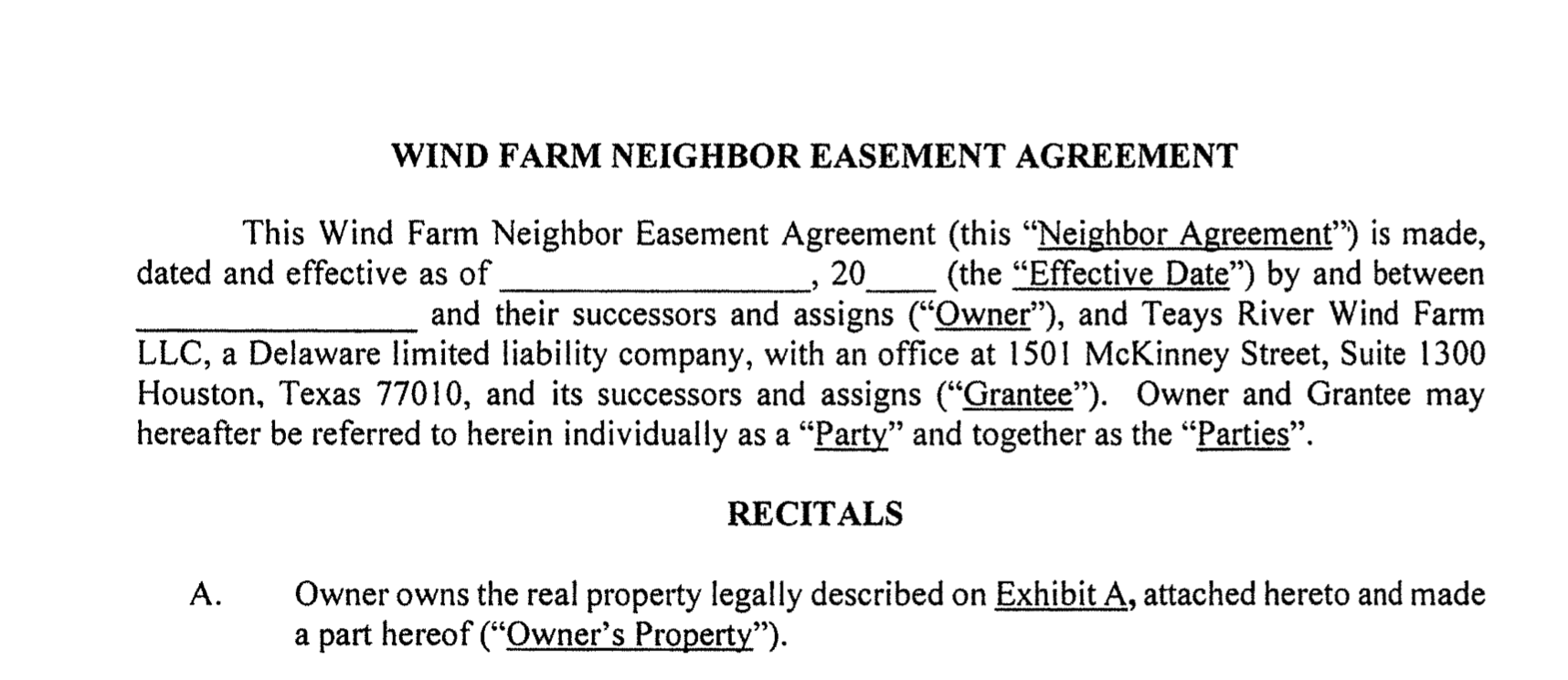
Disclaimer: The Blackford Ledger has obtained a copy of the "Good Neighbor Agreement" — formally titled "Wind Farm Neighbor Easement Agreement" — that has been circulating in Blackford County. The document is dated September 2025. The Ledger has not independently verified with EDP Renewables that this is the current operative form, and a later revision may exist.
The Teays River Wind Farm "Good Neighbor Agreement" is being passed around Blackford County as a goodwill gesture — a payment from EDP Renewables to landowners who won't host turbines but will live alongside them. It has been described locally as a respectful arrangement: a way of recognizing that people who will never see a check from the project itself will still live with its effects.
Read carefully, the agreement is not a payment for inconvenience. It is a release. In exchange for $15 per acre and $3,000 per occupied residence each year, a neighbor signs away — for fifty years, and for whoever inherits or buys the property after them — the right to sue EDP for noise, shadow flicker, vibration, electromagnetic interference, ice throw, blade overhang, television or telephone disruption, or "other effect of any kind whatsoever" resulting from the wind farm next door. They waive the protection of the county's setback ordinance. They agree not to oppose any future variance EDP files. They cannot, under any circumstances, terminate the agreement. EDP can terminate it any time, for any reason.
And while EDP's Teays River affiliate is asking Blackford County neighbors to sign these releases, EDP Renewables North America is, right now, six years into defending itself in a New York state court against a lawsuit brought by dozens of neighbors of one of its other wind farms — over the exact harms this agreement asks Blackford County residents to release in advance.
What the agreement actually does
The document, dated September 2025 and titled "Wind Farm Neighbor Easement Agreement," is offered to landowners adjacent to or near the Teays River Wind Farm who are not themselves hosting turbines. It is structured as a bundle of perpetual easements that run with the land for fifty years following commercial operation. An easement is a property right — the same legal instrument used to give a utility permanent access across a farm. Here, the easements EDP acquires are unusual in their scope.
The Effects Easement (Section 1) grants EDP a right to inflict on the neighbor's property "any audio, visual, view, light, vibration, air turbulence, wake, electromagnetic, ice or other weather created hazards or other effect of any kind whatsoever." Tucked into the same section is a separate restriction that has nothing to do with the turbines' effects on the neighbor — it is a permanent restriction on what the neighbor can do with their own land. Any new structure taller than 65 feet — a grain bin, a silo, certain agricultural buildings — requires "Grantee's prior written approval, in Grantee's sole discretion." For fifty years, the neighbor cannot build above 65 feet on their own farm without permission from a wind energy company in Houston.
The Sound Easement (Section 2) waives Indiana noise standards, permitting sound levels at the neighbor's home in excess of "applicable Indiana County, Township or City ordinance standards." A turbine is deemed compliant — meaning EDP owes no remedy — unless three measurements within a single hour all exceed the ordinance and none falls below 50 decibels.
The Shadow Easement (Section 3) grants EDP the right to cast shadow flicker on the neighbor's home — the strobe effect produced when sunlight passes through rotating blades, a documented source of sleep disruption. The mitigation EDP commits to is "tree planting or installation of awnings, draperies or other window treatments." Slowing or stopping the turbine is not on the list.
The Aerial License (Section 4) releases the common-law claim for aerial trespass from blade overhang. The Television and Telecommunications provision (Section 5) acknowledges the wind farm may "significantly interfere with or degrade" reception and caps EDP's obligation at installing a signal booster or paying for satellite TV.
After each of these waivers, the same clause appears: "Owner shall have no other remedy or claim against Grantee … except as stated herein."
The exit door only opens one way
The agreement runs for fifty years following commercial operation. During that half-century, Section 17 provides:
The Easements shall not be terminable by Owner under any circumstances.
Even if EDP defaults, the neighbor cannot end the agreement. In the same paragraph, EDP reserves the opposite right: "Grantee shall have the right to terminate this Neighbor Agreement at any time for any cause, by giving written notice of termination to the Owner." The company can walk away whenever it chooses. The neighbor cannot.
Section 14 makes the agreement a "covenant running with the land." The burden binds heirs, successors, anyone who inherits the property, anyone who buys it, and any lender who acquires it through foreclosure. A neighbor who signs in 2026 and sells in 2034 transfers the remaining forty-two years of waivers to the buyer, who never negotiated and never collected a payment. A neighbor who dies in 2040 leaves the obligations to their children.
Section 24 requires the neighbor to keep the terms confidential — meaning neighbors cannot compare what they signed with what their neighbors signed. Only a memorandum is recorded in the county land records (Section 26); the substantive terms stay off the public title record.
Arkwright: what EDP is being sued for, right now
On September 24, 2019, dozens of residents of Arkwright, New York, filed suit against EDP Renewables North America and several affiliated entities over the Arkwright Summit Wind Farm — 47 turbines erected in 2018. Richard Alexander et al. v. EDP Renewables North America LLC et al. remains in active litigation. On December 24, 2024, a New York state Supreme Court justice granted the plaintiffs leave to add additional plaintiffs.
According to the Post-Journal's reporting, the Arkwright plaintiffs are seeking damages for loss of property values, destruction of homes and lifestyle, loss of use and enjoyment, relocation costs, mental anguish, destruction of scenic countryside, physical pain and suffering, difficulty sleeping, nuisance, trespass, interference with electronics in their homes — including satellites, telephones, and televisions — loss of business profits, stress, anxiety, and "the effects lights and noise from the turbines have on their properties."
Read alongside the Teays River agreement, that list is almost a section-by-section index. Loss of use and enjoyment — released by the Effects, Sound, and Shadow easements. Destruction of scenic countryside — captured by the "visual, view" language in Section 1. Difficulty sleeping — tied to the Sound Easement's permission to exceed the local noise ordinance. Nuisance — captured by "other effect of any kind whatsoever." Trespass — released by the Aerial License. Interference with electronics — released by Section 5. Effects of lights and noise — Sections 2 and 3.
The Teays River form is dated September 2025 — six years into the Alexander litigation. The form circulating in Blackford County addresses each of those claims and asks neighbors to release them in advance.
The setback waiver
Sections 6.1 and 6.2 are the provisions least visible to readers skimming for the dollar figures, and arguably the most consequential. Section 6.1 waives the setback requirements in Section 1006 of the Blackford County Zoning Ordinance — the public protection that determines how close a turbine may be erected to a non-participating residence. The neighbor "consents to setbacks being less than required under the Zoning Law" and commits, on EDP's request and "without demanding additional consideration," to execute any further setback waiver EDP may want, within ten days.
Section 6.2 prohibits the neighbor from remonstrating against any petition for variance of those same setback requirements, and forecloses any claim against EDP "for a violation of any requirements or limitations set forth or identified in the Zoning Law."
The Blackford County setback ordinance is a public protection. What Section 6 does is privatize the waiver of that public protection — transferring it from a decision made by the county's planning bodies, in public, to a decision made in a confidential contract between a Portuguese-owned developer and a landowner offered $3,000 a year for an occupied residence and $15 an acre.
What it adds up to
The Teays River "Good Neighbor Agreement" is, in form, a payment instrument with releases attached. In substance, it is a release instrument with a payment attached. The document does not compensate neighbors for inconvenience. It compensates them for waiving claims — including claims that other neighbors of EDP wind farms, in another state, are currently in court trying to prove.
The agreement asks landowners who will never see a turbine on their own land to permanently restrict what they can build on it, accept noise above the local ordinance, accept shadow flicker on their homes, surrender their standing under the county zoning code, agree never to publicly oppose a future EDP variance, keep the terms confidential, and bind their children and any future buyer to the same.
It gives EDP, in exchange, the legal architecture to do all of this — and the right to walk away at any time, for any reason, while the neighbor stays locked in for fifty years.
That is what is being offered as a good neighbor.
About our reporting: The Blackford Ledger builds its government coverage from official public records, and every report is reviewed by an editor before publication. Read our Editorial Policy & Corrections or request a correction.