Residents brought Leeward complaints to the Commissioners this week. Most were told to see their attorney.
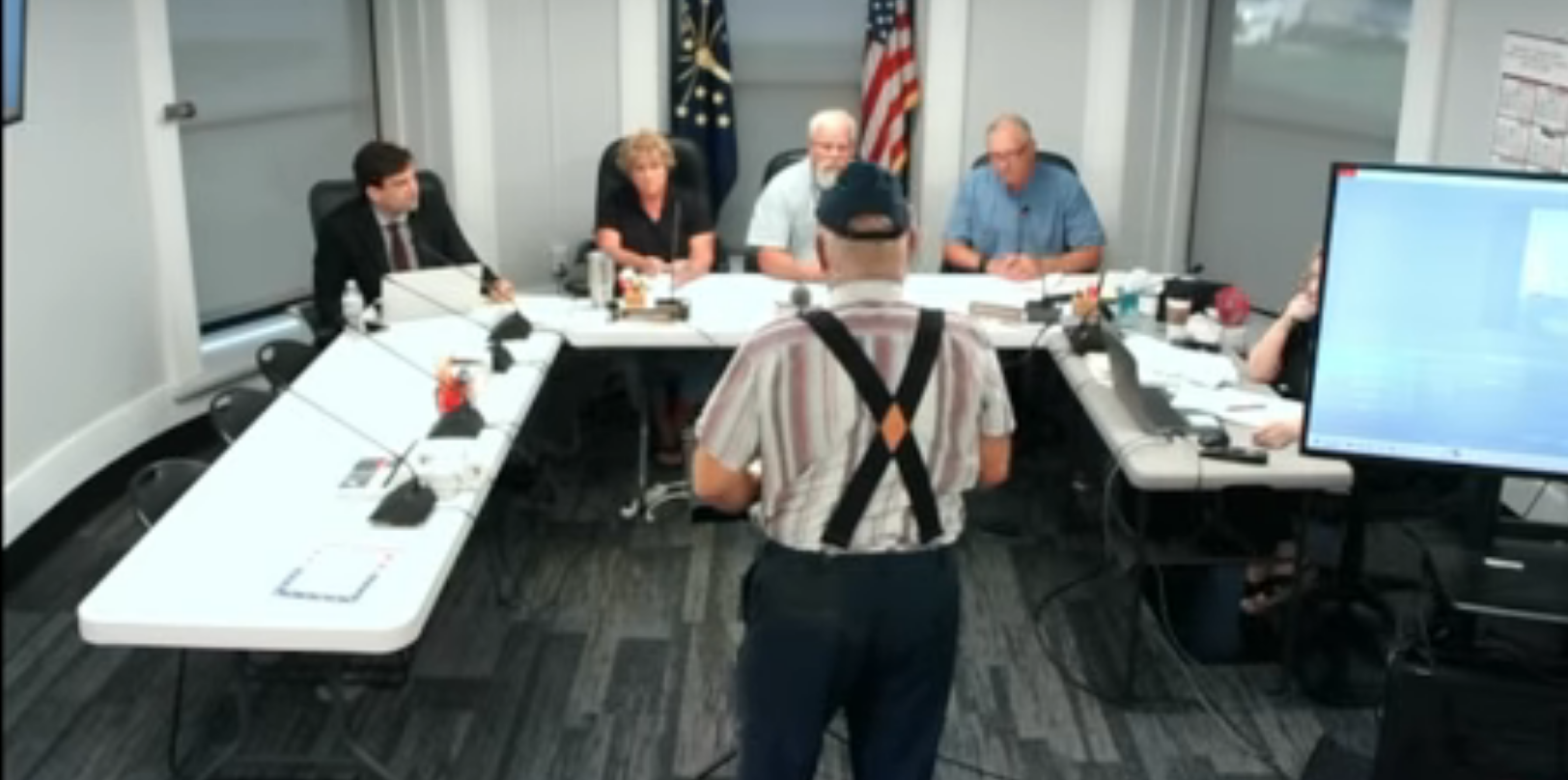
At the September 8 Blackford County Commissioners meeting, a few residents used the public comment period to raise specific problems with Leeward Renewable Energy, the developer of one of the county's wind projects. Their complaints spanned unpaid crop damage, delayed contract payments, buried cable depth violations, missing stone the residents believed they were entitled to under their contracts, and one landowner being fenced out of his own woods.
For most of the issues raised, the residents were told to talk to their attorney. On one, Commissioner Dan Borgenheimer offered his personal phone number to help.
What the residents said
The first resident told the Commissioners that Leeward construction crews had damaged the ditch on his property while running cabling. He said he had also not been paid for damage to his crops in 2025 or 2026. When asked what he was trying to accomplish by raising it, he said: "That's what I was trying to find, is up the ladder who I can contact."
Commissioner President John Lancaster told the resident he would need to talk to a county official identified as John about the ditch damage, and told him the crop damage claim was probably a matter for his attorney to take up with the company's attorney.
Borgenheimer then offered to help personally. "Why don't you just — I'll give you my phone number and you can call me and give me the details, and I'll see if we can get something done," he said. He asked the resident whether he was aware of others in similar situations, who replied he was.
The second resident told the Commissioners he had a signed contract with the developer that specified payment within 30 days of signing. He said he was paid 45 days later, after complaining about the delay. He also raised concerns about the depth of buried collection lines, which he said were supposed to be at least five feet in some places. He said the developer offered him the option to have the cable reburied to the specified depth or to accept a per-foot payment in exchange for leaving it as installed. He took the payment.
Their word ain't worth [anything]," the resident said. "I mean I got a written contract, I got verbal comments, and it doesn't matter, they just do what they want.
He also told the Commissioners that stone used by the developer to construct turn radiuses on his property was supposed to be made available to landowners first and to the county second, per his contract. He said the stone was removed without notice and he received none.
Finally, a resident said the developer had installed a fence around a wooded portion of his property, locking him out of his own woods. He said access to those woods had been discussed with the developer since the beginning of the project, most recently in May, without resolution.
Lancaster told him the Commissioners had raised the fence and access issue with Leeward in a meeting the previous week and were expecting an answer this week. "We meet with them every week," Lancaster said.
A pattern the Ledger has documented before
The complaints raised at the meeting fit a pattern the Ledger has previously reported.
In 2022, Leeward committed to the Board of Zoning Appeals to install a wildlife-friendly agricultural fence around its Blackford Solar project as a condition of approval. What was ultimately installed was chain-link fencing topped with barbed wire. The fence that went up did not match what had been committed to.
That earlier incident, and the accounts residents brought to the Commissioners this week, describe similar dynamics. Commitments made. Commitments not honored as agreed. Landowners left to pursue relief on their own.
The first resident's statement that he was aware of others locally with similar complaints, and the second resident's statement that others likely had not come forward, suggest the two accounts delivered at Monday's meeting may not represent the full picture.
The county's role, and its limits
The Commissioners' responses reflected a consistent position: private contract disputes between landowners and developers are matters for the parties' attorneys to resolve, not the county. That position is legally defensible. The county is not a party to the contracts residents sign with Leeward. The county cannot enforce their terms. This goes for all energy project agreements between residents and the project owner.
But the residents' presence at the meeting suggests they view the county as having some responsibility. Both residents specifically asked whom "up the ladder" they could contact. Both traveled to the courthouse and spoke on the record about problems with a developer that received a substantial tax abatement from the county and continues to operate here under agreements the county signed.
Lancaster's own words indicate the county is not entirely at arm's length. The Commissioners meet with Leeward weekly. They raised the fence issue with the company. They expect a response.
The question the residents were raising, in different words, is whether that ongoing county engagement extends to holding developers accountable for the private commitments they make to residents whose land they use — or whether it stops at the tax abatement and the road use agreement.
About our reporting: The Blackford Ledger builds its government coverage from official public records, and every report is reviewed by an editor before publication. Read our Editorial Policy & Corrections or request a correction.