'If you build it, will they come?' A sports complex emerges as one idea for Blackford County's energy-project money
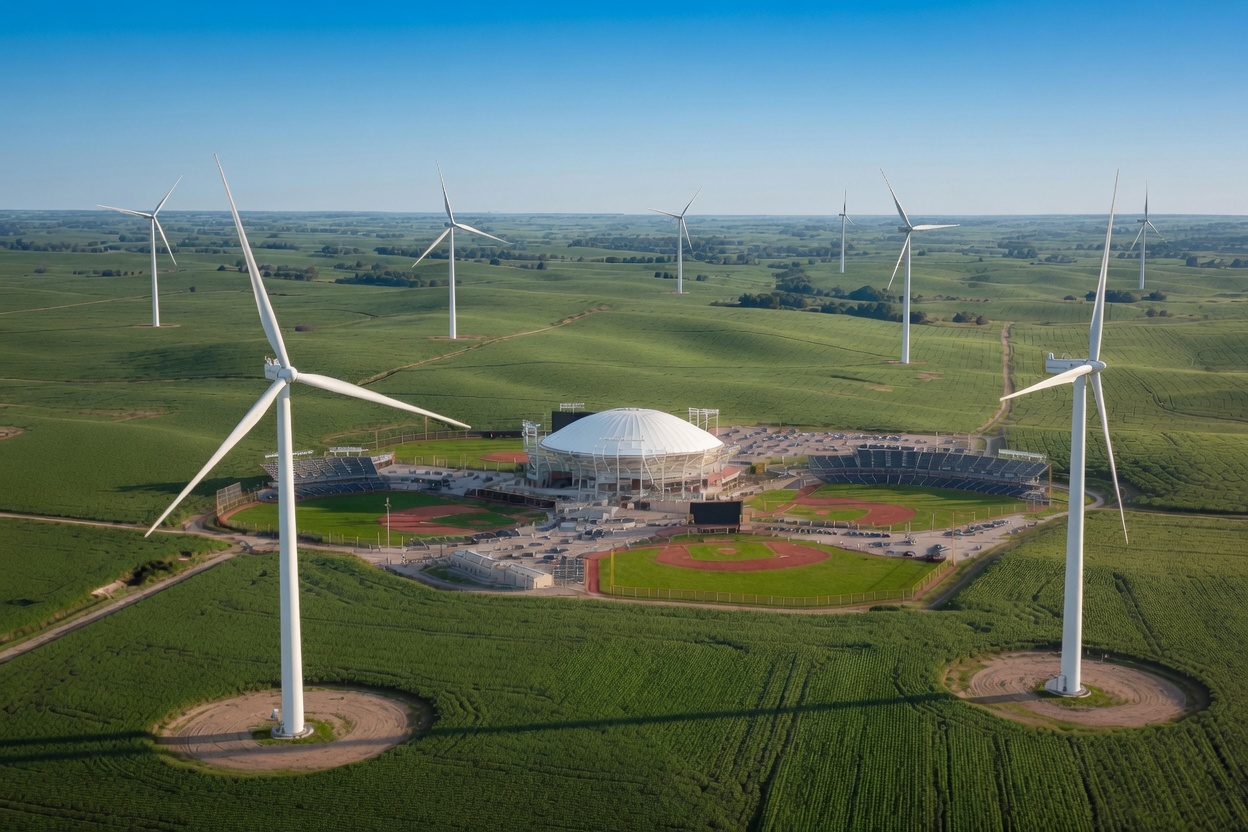
Ever since the Blackford County Council and Commissioners began approving tax abatements and Economic Development Agreements with renewable-energy developers, one question has come up again and again from residents: where is the money going to go?
It has been asked openly during the public-comment portion of Council and Commission meetings. It has been asked privately, on Facebook, at coffee shops, and across kitchen tables. Officials have offered general answers — economic growth, quality-of-life improvements, reversing the county's long decline — but no specific project has been formally proposed, debated, or voted on.
One idea, however, has bubbled to the surface more often than any other: a sports complex.
Recently, a sitting Council member — Casey Dick — became the first elected official on record to name that complex as an example of how the county could spend the roughly $51.5 million in conditional payments it expects to receive from its renewable-energy agreements. In an interview with the Ledger, Dick stopped short of endorsing the complex as a firm plan, and no formal proposal has been brought to either the Council or the Board of Commissioners.
What Dick said
Asked about the common public criticism that council members have not said what they plan to do with the abatement-driven payments, Dick first noted that the money does not yet exist to be spent — none of the six renewable-energy projects have begun generating revenue for the county. He then offered the sports complex as one of the ideas already in circulation:
There was an idea brought up, I don't know two months ago for a sports complex. I know that there's some people that don't want that to happen or think it's a waste of money, but there is huge economic growth with those facilities.
Dick compared the idea to Grand Park in Westfield, citing visitor traffic in the range of two to four hundred thousand people a year and the secondary development — hotels, mid-tier restaurants, sports retail — that often follows such facilities. "If it's spent right," he said of the EDA money, "it can change the landscape of life we're having."
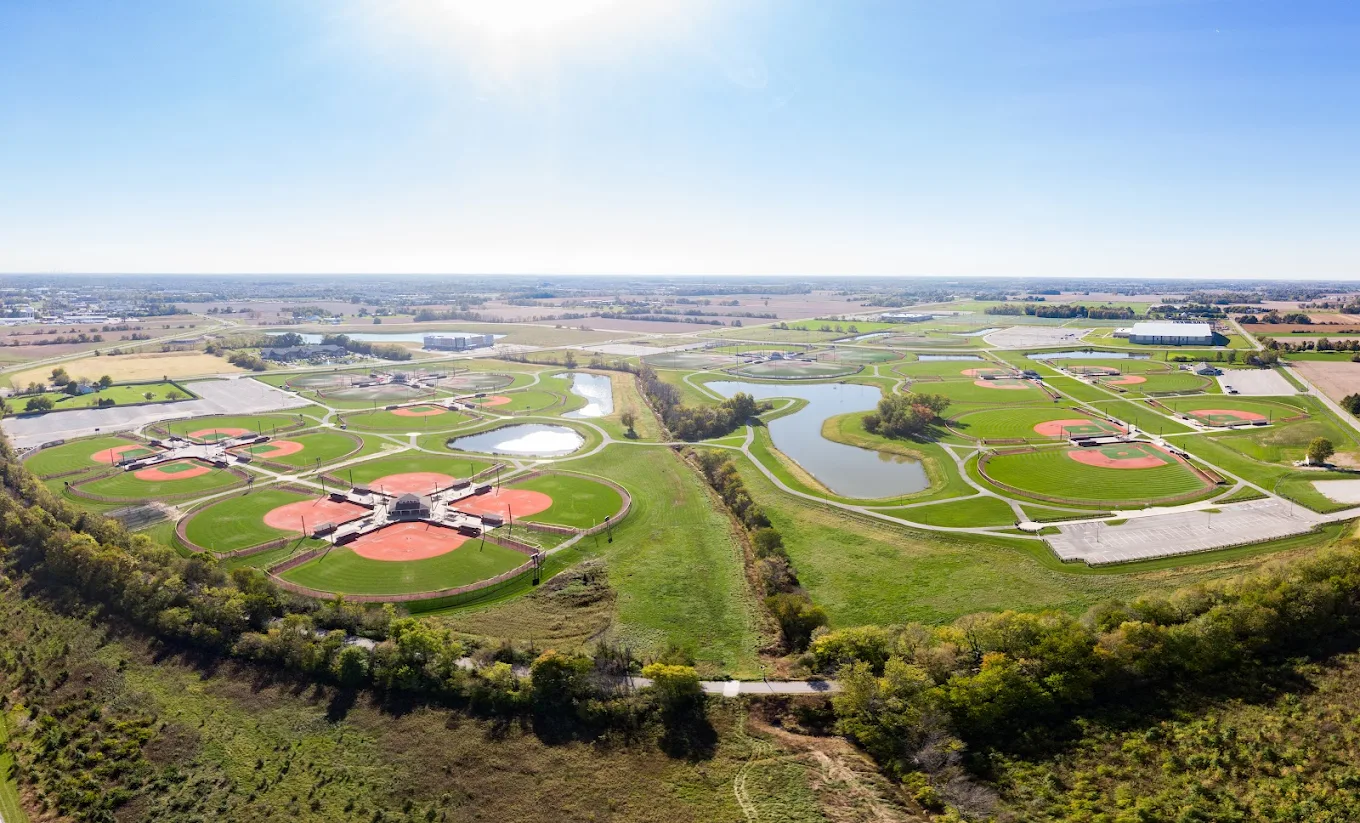
Photo: Grand Park Sports Campus - Google Photos
He was clear, however, that he was not committing to the sports complex as his preferred use of the funds. "I like the idea," he said. "I'm not saying that's going to be the idea that I stick my flag in." He also acknowledged that any decision about how the money is spent has yet to be made by the Council as a body.
What's actually in the public record
The sports complex was presented once, to the County Council on January 7, 2026, by two Hartford City residents — one a local business owner, the other a baseball coach. The concept they pitched included eight outdoor fields and an indoor dome facility at an estimated cost of $15 million to $25 million, with the possibility of using "some appropriated county funds" as part of the financing.
The Council asked the presenters for source documentation on their revenue projections, and Council President Jack Beckley specifically asked for verification of the figures. According to our records, no follow-up appearance by the presenters is recorded in any meeting since.
The energy-project payments came from a separate presentation, four months later. On May 6, 2026, Blackford County Economic Development Corporation Executive Director Warren Brown told the Council that, if all six of the county's renewable-energy projects are funded and built, the total payments to the county would come to $51,537,499. Brown told the Council the money "can be used for anything that is legal for you to appropriate to."
That figure is conditional in two important ways: it assumes all six projects — including EDP Renewables' Teays River project, where land acquisition is still in progress — get built; and none of the payments have yet been received. The single largest piece, roughly $7.84 million, is tied to RWE's Prairie Creek Wind Phase 2, the project the Commissioners most recently approved an Economic Development Agreement for on June 15.
How Dick framed the broader question
In the same interview, Dick laid out a wider frame for how he thinks about the EDA money. He described the county as being on a "steady decline" and argued that without an influx of investment, "we're in rough shape." He said his vote in favor of the abatements was driven by the prospect of "a pot of new money that can be spent on anything," with the goal of reversing population loss and stagnant economic activity.
He said that when he asks residents who criticize the abatements what they would do with the money instead, "I've only met like two or three people that had an idea." He emphasized that he raises the question, in his telling, not to dismiss critics but to surface alternatives.
What's not in the record
No other council member or commissioner has publicly identified the sports complex — or any other specific project — as a preferred use of the EDA payments. The Ledger has reviewed every 2025 and 2026 county meeting transcript on file; no formal discussion of allocating EDA payments to a sports complex has occurred in any open meeting.
Any decision to spend EDA money on a specific project would, under Indiana law, require appropriation by the County Council in a public meeting. To date, no such appropriation has been proposed.
The Blackford County Ledger is an independent local-government accountability outlet covering Blackford County, Indiana.
About our reporting: The Blackford Ledger builds its government coverage from official public records, and every report is reviewed by an editor before publication. Read our Editorial Policy & Corrections or request a correction.