Blackford County BZA took a vote without public notice. State law might have required it.
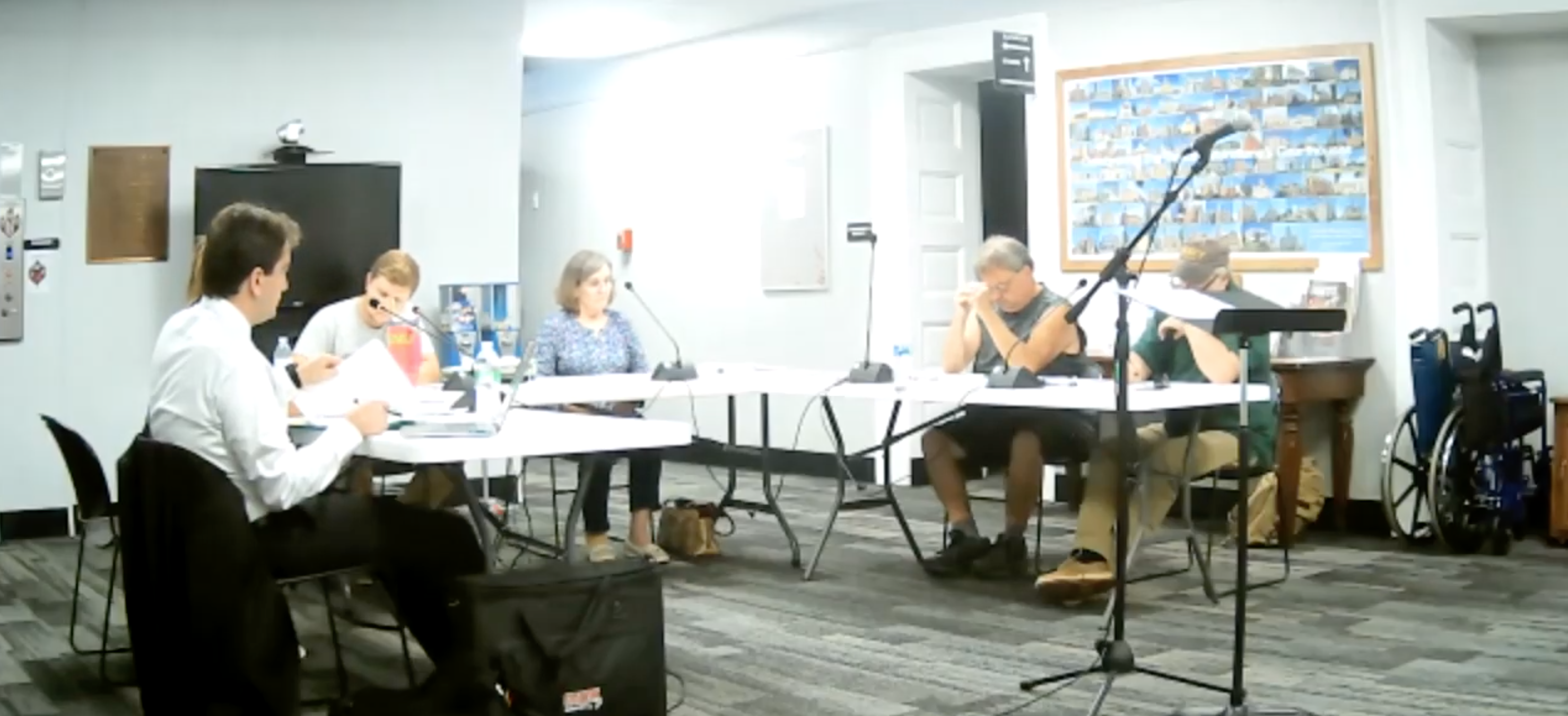
At its September 15 meeting, the Blackford County Board of Zoning Appeals voted to confirm that a 2022 special exception for the Blackford Solar project covers a parcel that was never listed in the original application.
The item was not publicly noticed before the meeting. The agenda was available for pickup at the door. As of publication, it has not been posted to the county's meeting agenda site.
When a resident asked at the meeting whether the item had been legally noticed, county attorney John Moynihan of Beasley & Gilkison advised that notice was not required because the matter was a correction.
The board then took a motion, a second, and a vote.
The details of what happened
Blackford Solar, developed by Leeward Renewable Energy, asked the board to confirm that its 2022 special exception approval encompassed parcel 06-26-20-000-004.001-0, a roughly 18-foot-wide strip running about 2,000 feet north-south. It's not large, but every section of county land being built on typically requires an Improvement Location Permit (ILP) for construction to begin. Of which, Blackford Solar had 23 before Tuesday's meeting.
The parcel was omitted from the parcel schedule submitted with the 2022 application. Leeward's representative characterized the omission as a scrivener's error, noting the strip appeared on site plans submitted with the application even though it was not identified as a separately owned parcel. Though the map is enough to visibly show where the work is being done, both visual representation and legal description are required under Blackford County ordinance in order to obtain an ILP.
After a brief conversation, The board voted to include the parcel. The motion, as stated at the meeting, was "to include the parcel as intended due to a scrivener's error."
After the vote, the county was positioned to issue the project's final improvement location permit, which Planning and Zoning Executive Director Samantha Dick had held pending clarification.
What state law says about notice
Indiana Code 36-7-4-920 governs hearings before a county board of zoning appeals. Subsection (b) reads:
Public notice in accordance with IC 5-3-1-2 and IC 5-3-1-4 and due notice to interested parties shall be given at least ten (10) days before the date set for the hearing.
That requirement attaches to hearings on administrative appeals, exceptions, uses, and variances.
The county's position appears to be that confirming a scrivener's error on a previously granted special exception is none of those things, and so the ten-day notice requirement does not apply.
That interpretation might not be correct.
Why the characterization is open to question
Several features of the September 15 proceeding sit uneasily with the description of it as a routine correction.
This mistake may or may not be a "scrivener's error". A scrivener's error is defined as, "an unintentional typing, clerical, or transcription mistake in a legal document that does not reflect the true intent of the people who made it." (LSD.law).
A scrivener's error is a clerical or transcription mistake - a typo, a transposed digit, a line dropped in copying, a wrong parcel number keyed in. The defining feature is that the party knew the correct information and the document failed to reflect it. The error is in the writing down, not in the knowing.
What Leeward described is different. Their representative's own account was that they didn't realize the strip was a separate parcel with a separate owner. That's a title search or due diligence issue. They didn't write the wrong thing; they seemingly didn't know the right thing.
The board took formal action. Under IC 36-7-4-915, a board of zoning appeals must keep minutes, record the vote on all actions taken, and make written findings of fact in all cases. The Blackford County BZA treated this matter as requiring a motion, a second, and a recorded vote. A proceeding that requires a recorded vote is a proceeding in which the board acted.
The relief requested was substantive. Leeward's representative asked the board to confirm that its 2022 approval "encompassed the subject area," and cited two Indiana appellate decisions for the proposition that a board has authority to correct or approve its own prior decisions. Authority to revisit a prior decision is not something a party needs to establish in order to obtain a clerical correction.
The parcel was not before the board in 2022. The board's findings in 2022 addressed the parcels listed in the application. This parcel was not among them. Whatever the reason for the omission, the effect of the September 15 vote was to extend the reach of a 2022 approval to ground the board had not previously considered.
The vote unblocked a permit. The county had withheld the project's final ILP pending resolution. The vote resolved it. A proceeding that determines whether a permit issues has a practical effect on the property involved.
Leeward's own representative said the statute doesn't address the situation. At the meeting, he stated that nothing in the county's solar ordinance and nothing in the state zoning statute speaks to the scrivener's error question, which is why he turned to administrative procedure cases by analogy.
If the statute does not clearly resolve whether notice was required, then the county made an interpretive choice. It chose the reading that required no public notice, on a matter the board resolved by vote.
What notice would have cost
Ten days' published notice under IC 5-3-1 is an ordinary expense of county zoning administration. The same meeting already had provided notice for the IU Health Blackford Hospital signage matter heard that very evening.
Providing notice on the Blackford Solar item would have been simple and carried two benefits regardless of whether it was strictly required.
It would have given adjoining landowners and interested residents the opportunity to appear and be heard on a question involving the scope of a 1,200-acre solar project's zoning approval.
And it would have removed any question about the validity of the board's action. A vote taken after proper notice is not subject to challenge on notice grounds. A vote taken without notice, on an unsettled question of whether notice applied, remains open to that challenge.
Under Indiana law, a person aggrieved by a BZA decision may seek judicial review. Whether anyone will is a separate question. The county has created the opening.
About our reporting: The Blackford Ledger builds its government coverage from official public records, and every report is reviewed by an editor before publication. Read our Editorial Policy & Corrections or request a correction.