After seven months without meeting, Blackford County's plan commission moved to halt new energy and data center applications
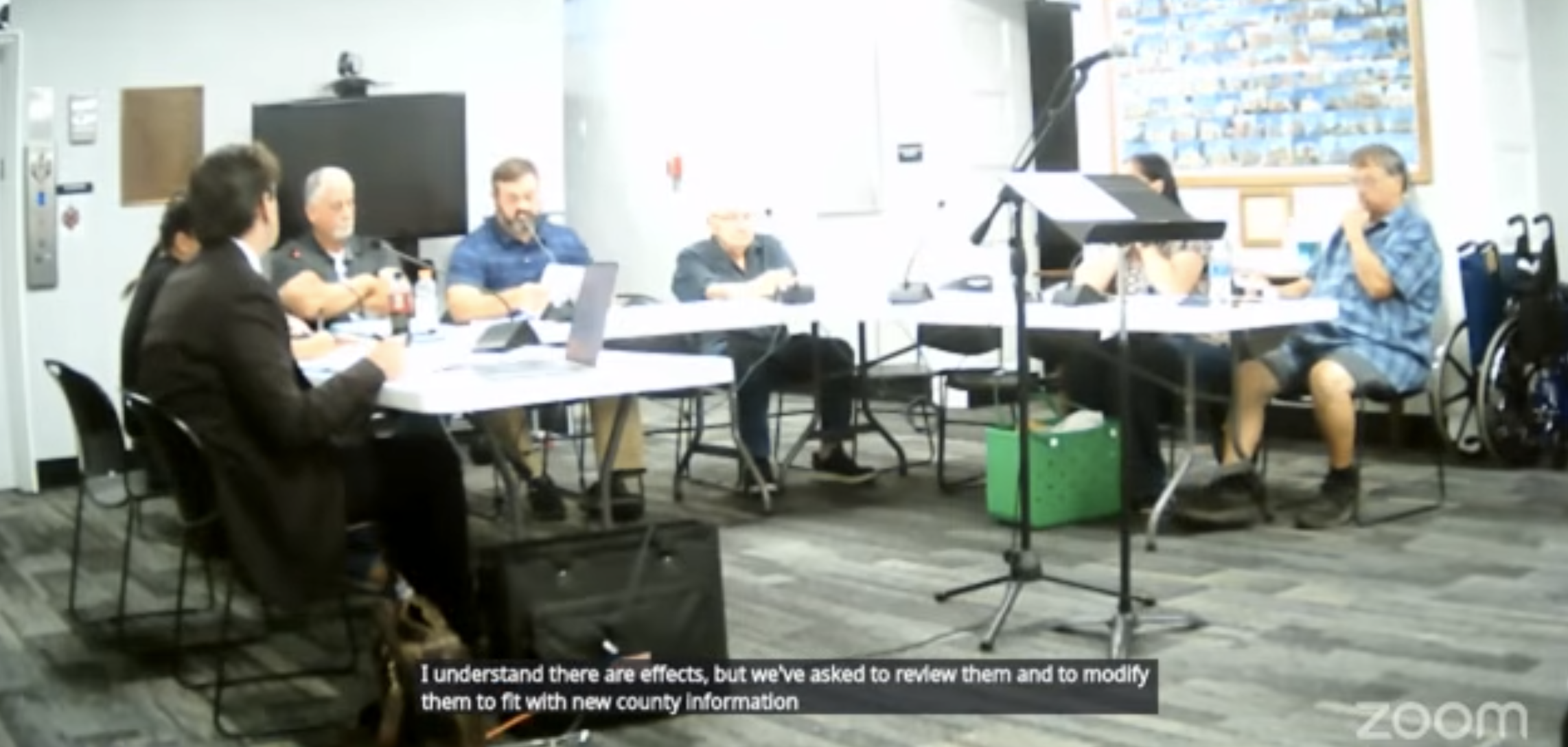
The Blackford County Area Plan Commission met October 6 for the first time since February 3. In roughly 40 minutes, it voted three times to begin shutting the door on new applications for data centers, wind projects and solar projects until the county's ordinances are written.
None of the three is in force. Each vote directs the commission's attorney, John Moynihan, to draft a resolution for the board to review and approve at its November meeting. But the direction marks a shift for a body that had three scheduled meetings cancelled or marked as no meeting between February and September.
Area Plan Commission Member Kerra Armstrong brought all three forward.
Data centers
Armstrong opened by naming the gap. "We do not have an ordinance for the data centers currently in our books," she said. "Until we get an ordinance put in place, in my opinion, to protect all of us, I would like to institute a resolution that we do not accept applications for any data centers until we have an ordinance put in place going forward."
The practical effect, as she described it, would be that Planning and Zoning Executive Director Samantha Dick could not approve a data center permit while the resolution stands.
Board members discussed what tool actually applies. A moratorium is the stronger option, but one member said the commission cannot impose one on its own. That would require a request to the Commissioners, approval from all four entities in the county's planning jurisdiction, and a public hearing. A resolution is narrower: a directive to the planning office, not a change to the zoning ordinance.
One member described how two other Indiana counties handled it. Cass County and Marshall County define a data center in their zoning ordinances and then state that a data center is not an allowable use within their jurisdiction.
Another member raised a caution that no-zoning is not itself protection. "There's been some cases in other states that have shown that no zoning was not a protection," he said.
Armstrong pointed to what she had been hearing locally. "I'm just concerned that with some of the water cooler talk, it's going to put us in a bad situation with not having any regulations for them to follow." Asked later whether a specific project was pending, she said the commission did not know, but "that's the word on the water cooler, that they're going around and trying to get leasing permits."
The board voted to task Moynihan with drafting the resolution for review at the November meeting. It passed unanimously.
Because November 3 is Election Day, the board separately voted to move its November meeting to November 10.
Wind & Solar
Armstrong then turned to the wind ordinance revision, which has been with outside counsel since early this year.
"With us taking so long to review the solar ordinance, I think we've put this county, this board, the BZA board and several other entities in our county at a disadvantage," she said.
She laid out the timeline as she understood it. The committee the Commissioners assembled was told to finish the wind ordinance in a month. "We are now going on 10, 9, [months]" she said.
"If that is their true knowledge base, it shouldn't take 10 months to get it through," Armstrong said of the attorneys handling the review. "I had a 40-page trust put together in two months. That was very, very difficult and convoluted. I don't think that this should be that hard if this is their area of expertise."
She said she had asked repeatedly to have the matter placed on the agenda. "I feel like we are not pushing and that's what we need to do."
Armstrong also connected the delay to the Prairie Creek Phase 2 agreement. "The commissioners have in their economic development agreement tried to change the zoning ordinance and so [sic] zoning setbacks," she said, "and with that I find that we are now at a disadvantage."
Her framing of the board's own role was direct. "At some point we need to put pressure on the attorneys to get this completed. That is our job. That has been what we are tasked with. Whether we like it or not, it doesn't matter."
She added: "In my opinion, as a project, it's unacceptable. If I drug my feet like this at my place of work, I would be out of a job."
One member described the enforcement problem he sees underneath the ordinance delay. "Public sentiment is that the economic development agreements are not enough," he said. "The solar and wind companies have both violated those multiple times, and the answer has been to adjust the development agreement rather than hold the company responsible for different issues that have popped up. I think the root cause is an ordinance that is too lax."
The same member pointed to a property on 500 East. The developer "surrounded the house," he said. "They had over 150 acres to choose from and they chose to put everything within 50 feet of his property line. That is the reason for zoning."
The board voted to have Moynihan draft a resolution declining new wind permit applications until the wind ordinance is complete, to be presented after November 10. Members noted the resolution would apply only going forward and could not affect projects already approved or applications already filed.
The solar ordinance has moved less far than the wind ordinance, and in public comment a member of the ordinance committee described where it stopped.
The committee spent about three months on the solar draft, she said, because few Indiana counties had solar ordinances at the time and the group had to study what other counties were doing. The committee handed it in.
"It went nowhere," she said. "Absolutely nowhere."
By her account, the solar draft never reached the attorney for the language review the wind draft received, and never came back to the committee. A board member confirmed Dick has a copy.
The board discussed whether to take the raw committee version and work from it directly, rather than route it through the attorney twice. "That's a double dip on money," Armstrong said.
Armstrong then moved for a third resolution: no new solar applications accepted until a solar ordinance is in place. It was seconded and passed.
What happens next
All three resolutions return to the Area Plan Commission on November 10 for review and a vote. If adopted, they direct the planning office to decline new applications in each category until the corresponding ordinance is in place. They do not reach projects already approved or applications already filed.
About our reporting: The Blackford Ledger builds its government coverage from official public records, and every report is reviewed by an editor before publication. Read our Editorial Policy & Corrections or request a correction.